Egyptians protest for 2nd day after soccer loss

Fri Nov 20, 2009 12:56pm GMT
 

CAIRO (Reuters) - Demonstrators gathered for a second day near the Algerian embassy in Cairo on Friday to protest against what they said was violence against Egyptians during a play-off for the World Cup soccer finals.

Egypt recalled its ambassador to Algeria on Thursday, accusing Algerian fans of thuggery during the match in Khartoum on Wednesday, which Algeria won 1-0 to qualify for the World Cup in South Africa next year.

The Interior Ministry warned Egyptians against further protests after 11 police officers and 24 demonstrators were injured in riots near the embassy at dawn on Friday. Such demonstrations are almost unheard-of in Cairo.

"The police will be forced to take steps it sees necessary in the case of any other contraventions of the law," the ministry said in a statement.

About 150 demonstrators gathered on Friday in the Zamalek neighbourhood, where many embassies are located.

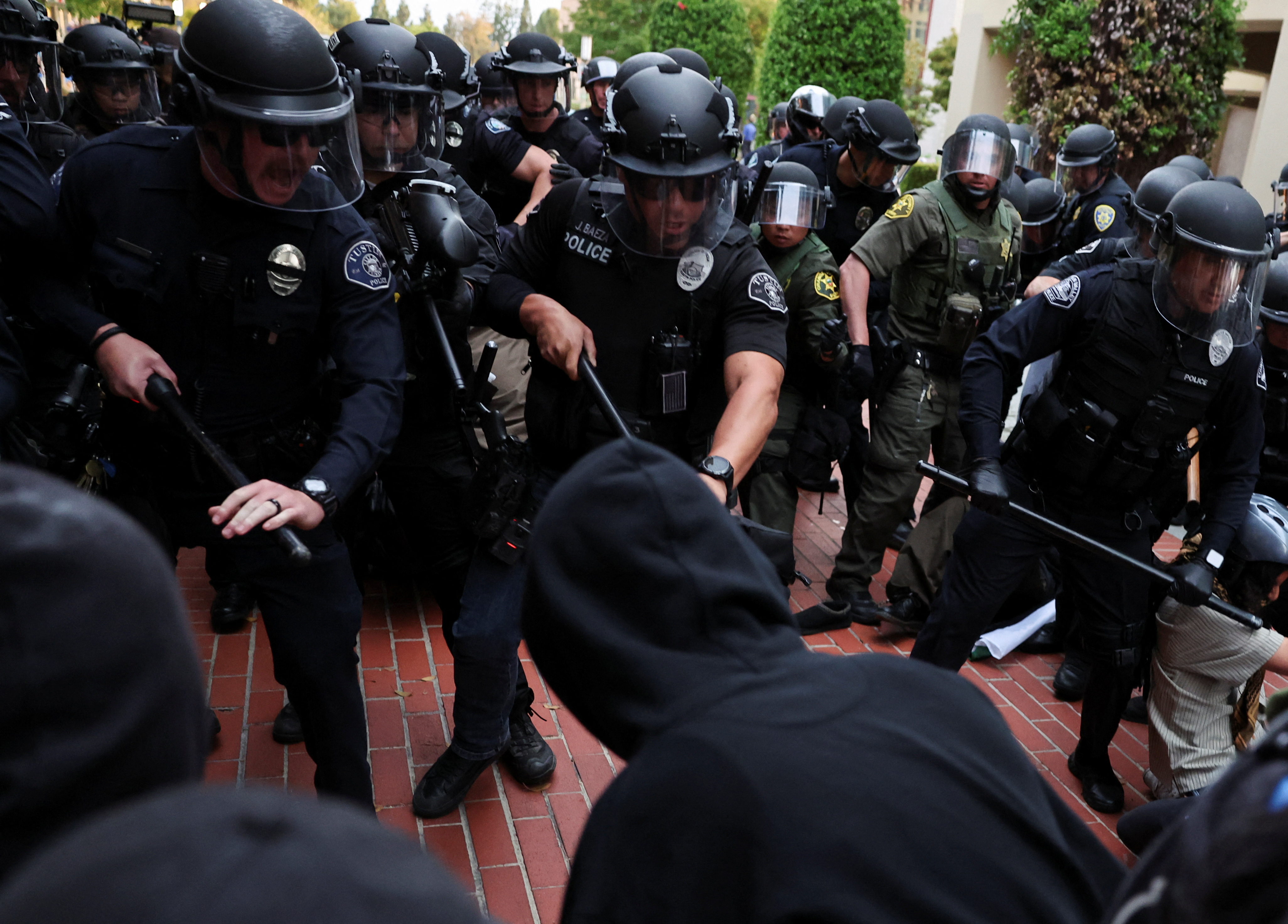
Police trucks and hundreds of officers in riot gear formed a cordon along the streets to block their way to the Algerian embassy, a Reuters witness said.

"One, two, where's the ambassador gone to?" they chanted in Arabic.

Passing cars hooted and some waved Egyptian flags in support of the demonstrators. Stones and broken glass from the previous night's violence littered the street.

Reuters witnesses said about 2,000 demonstrators gathered during the night and many began throwing bottles and stones after a police charge to break up the crowd. Two police vehicles were overturned.

The windows of four shops, a petrol station and 12 glass billboards were shattered and 15 private and police vehicles were damaged during the dawn riots, the Interior Ministry said.

<p>Egyptian demonstrators protest near the Algerian embassy in Cairo November 19, 2009. REUTERS/Asmaa Waguih</p>
Libya's former leader Muammar Gaddafi (L) welcomes Egypt's former President Hosni Mubarak as he arrives to attend a meeting involving five Arab states in Tripoli June 28, 2010. REUTERS/Stringer
Will 2012 see more strong men of Africa leave office?

There are many reasons for being angry with Africa ’s strong men, whose autocratic ways have thrust some African countries back into the eye of the storm and threatened to undo the democratic gains in other parts of the continent of the past decades.  Blog 

 
Kenyan troops patrol the Garrisa airstrip October 18, 2011. Al Qaeda-linked militants prepared to defend a south Somali town on Tuesday from advancing Kenyan and government troops, while a suicide car bomb killed six people in Mogadishu during a visit by a Kenyan minister.  REUTERS/Gregory Olando
Operation Somalia: The U.S., Ethiopia and now Kenya

Ethiopia did it five years ago, the Americans a while back. Now Kenya has rolled tanks and troops across its arid frontier into lawless Somalia, in another campaign to stamp out a rag-tag militia of Islamist rebels that has stoked terror throughout the region with threats of strikes.  Blog 

 
New recruits belonging to Somalia's al-Qaeda-linked al Shabaab rebel group march during a passing out parade at a military training base in Afgoye, west of the capital Mogadishu February 17, 2011. REUTERS/Feisal Omar
Could Islamist rebels undermine change in Africa?

Creeping from the periphery in Africa’s east and west, Islamist militant groups now pose serious security challenges to key countries and potentially even a threat to the continent’s new success.  Blog 

 
A disabled Somali refugee child crawls from their makeshift house at the Ifo camp near Daadab, about 80km (50 miles) from Liboi on the border with Somalia in north-eastern Kenya, February 4, 2009. The growing flow of Somalis fleeing conflict at home has led to overcrowding in refugee camps in neighbouring Kenya and the United Nations expects the influx to continue, an official said. REUTERS/Noor Khamis
The children of Dadaab: Life through the lens

Through my video “The children of Dadaab: Life through the Lens” I wanted to tell the story of the Somali children living in Kenya’s Dadaab. Living in the world’s largest refugee camp, they are the ones bearing the brunt of Africa’s worst famine in sixty years.  Blog 

 
Zimbabwe's President Robert Mugabe (R) and his Equatorial Guinea counterpart Teodoro Obiang Nguema Mbasogo arrive for the opening of the Harare Agricultural Show, August 31, 2007. President Robert Mugabe on Friday imposed a new law on Zimbabwean businesses banning them from raising wages to keep pace with the world's highest inflation. REUTERS/Philimon Bulawayo
Who among the seven longest serving African leaders will be deposed next?

Several African leaders watching news of the death of Africa ’s longest serving leader are wondering who among them is next and how they will leave office.  Blog 

 
Tibet's exiled spiritual leader the Dalai Lama jokes with photographers during a news conference  in Sao Paulo September 16, 2011.  REUTERS/Nacho Doce
Was South Africa right to deny Dalai Lama a visa?

Given that China is South Africa’s biggest trading partner and given the close relationship between Beijing and the ruling African National Congress, it didn’t come as a huge surprise that South Africa was in no hurry to issue a visa to the Dalai Lama.  Blog 


Powered by Reuters AlertNet. AlertNet provides news, images and insight from the world's disasters and conflicts and is brought to you by Reuters Foundation.